
The Wellington Diocese gathers for its 69th Synod next Friday and Saturday.
By Petra Oomen and the Anglican Movement Comms Team
This article, has been adapted from the original published by the Nelson Diocese (here). Many thanks to Petra Oomen for her work on this series and allowing us to use this worthwhile material.
Every year, the bishop(s), ministry coordinators, vicars and parish representatives from all over the diocese gather in one place for the weekend to do business. It’s called synod.
Synod is a formal governance meeting, almost like a parliament meeting, where statutes and matters of policy are decided, reports are received, and members of diocesan committees are elected.
Synod shows what makes Anglican leadership different from other denominations: we make decisions together – bishop, lay people and clergy. Every parish in a diocese is represented and given the opportunity to have their unique voice heard.
Our guide to synod “Synod Key Information” says synod representatives, “have an important role to help all our people – both clergy and lay – to realise Jesus’ mission for our Diocese by shaping the strategy and operation of our Diocese, by representing your parish or mission unit in Synod decision-making and by helping to bring information from Synod back to your parish or mission unit.”
But what does it actually look like? Let’s start with a glance around the room.
Who’s in the room?
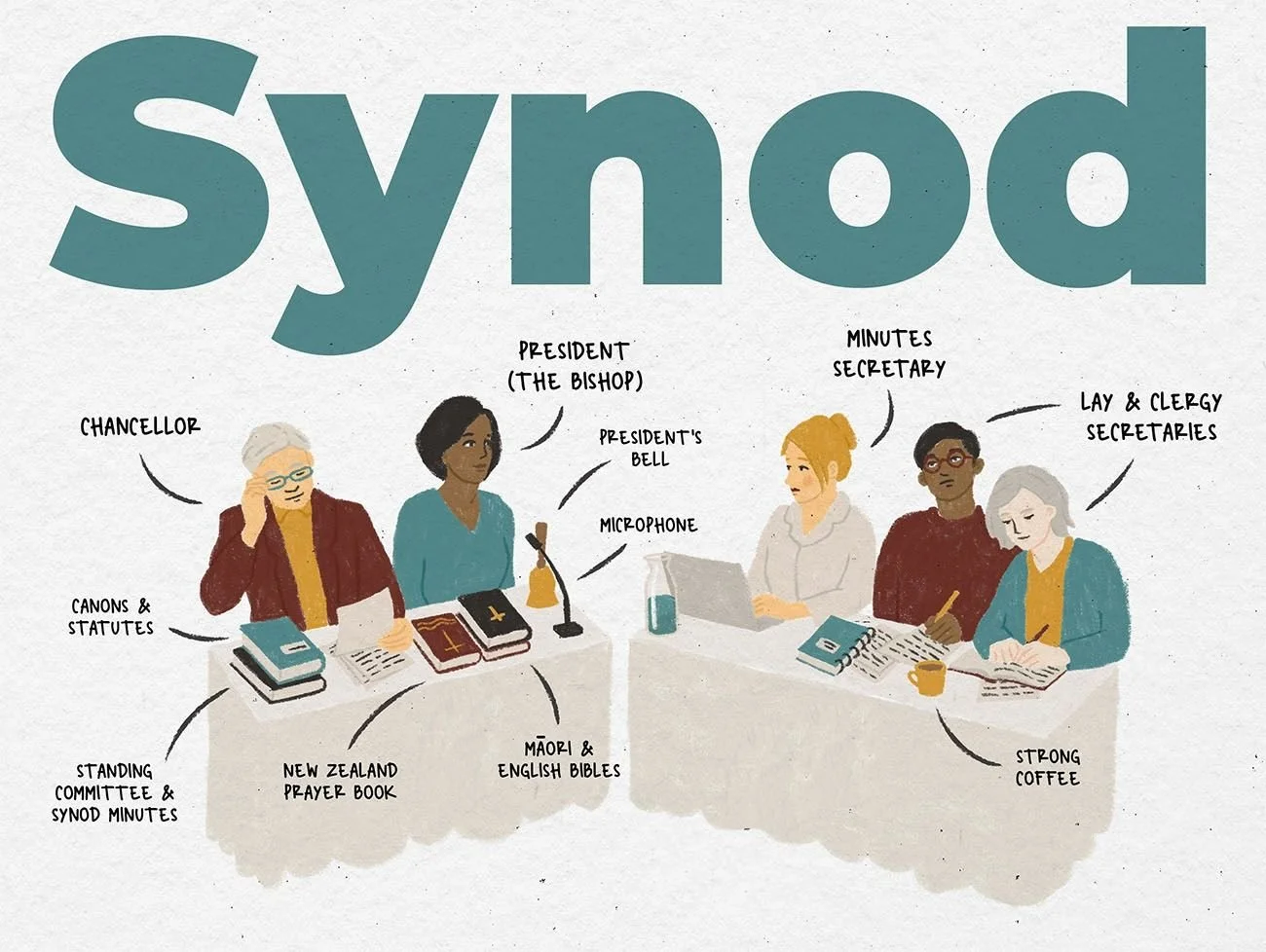
ILLUSTRATION BY PETRA OOMEN
When synod is gathered for business, sitting at the front are the following:
The president. This is the bishop, who chairs synod. Up to four members of synod can also be appointed by Standing Committee that the bishop may invite to preside as chair from time to time.
The diocesan chancellor. The chancellor is the official legal adviser to the bishop, checking that the business carried out at synod is legislatively correct.
The secretaries. There must be one clergy and one lay secretary, appointed by the bishop.
The rest of the members are seated around tables, arranged by parish or mission unit.
Every parish is represented with their licensed clergy and two or three synod reps, depending on the population of the parish. There are about 220 people attending synod this year.
All voting members fit into one of three “houses”. The house of bishops consists simply of the bishop, the house of clergy is all licensed priests and deacons, and the house of laity is made up of the lay synod representatives. Every vote requires assent from all three houses.
The diocesan manager is present, along with some other members of the Anglican Centre like the bishop’s chaplain and the finance manager. There are usually a few people representing various institutions – such as our mission partners Anglican Missions and NZCMS.
There are two relevant “rights” in play for every person. The right to speak, and the right to vote. Active clergy and lay representatives have both speaking and voting rights. The diocesan manager and ministry enablers have the right to speak, but not to vote. Any other attendee (not licensed by the bishop or approved under our canons) must be given speaking rights if they are to speak during business sessions.
What happens at synod?
On the first evening, a public service is held, where people gather for worship and prayer before the bishop delivers a “charge”. The bishop’s charge is an official instruction to the whole diocese, made with discernment of what the Spirit is saying to the church. This sets the direction for ministry and mission for the coming year.
On the next day, the business begins. This will include:
Motions. Almost everything synod resolves starts as a motion. There are routine ones, like a motion to bestow speaking rights, a motion to receive the budget report and approve the year’s budget, and so on. There are also motions addressing particular issues – there might be a motion to accept a funding recommendation, a motion that Standing Committee reviews a matter, or simply a motion of thanks. Motions are distributed to members of synod in advance, so people can spend time considering them. Motions have movers and seconders, and particular rules apply when speaking about them. For example, members must always address the president directly when talking, and speeches are time-limited – up to eight minutes for the mover and five minutes for subsequent speakers.
Reports. Members of synod must consider the reports and accounts of the many diocesan bodies. Each parish submits a report that outlines the successes and challenges of the year, including any relevant news and updates. The same with all ministry coordinators and diocesan committees and boards – one or two pages on what has been happening and where God has been leading. All reports are circulated to members in advance and put into the official annual synod yearbook.
Elections. Synod is responsible for electing various people, such as Standing Committee members (the “synod between synods”), General Synod representatives (sent to the national Anglican synod) among others.
While Synod is often formal, it’s also a time of gathering to worship and pray with our Movement whānau for the purposes of God among us. It opens and closes with prayer and worship - reminding us - that we are one body united under Jesus.
Synod ensures that every parish has a voice, every board and committee is kept accountable, and every part of the diocese is on the same page as we seek to be a transformative movement of local faith communities.
