
Testimony on Palestine Heard
The Church of England's General Synod has voted to hear Palestinian Christian testimony on Gaza, as famine spreads across the Holy Land.
A contested debate in York, a worsening crisis on the ground, and one small Anglican hospital still treating the wounded.
We are thankful for the work of Anglican Missions in putting this story together - we republish it here with their permission.
You can support Anglican Missions work in Palestine by making a donation towards the Al Ali Hospital.
Also, see our events section for the chance to hear from two excellent speakers from Palestine brought to New Zealand by Christians for Peace in Palestine.
Church Times
Pray the News:
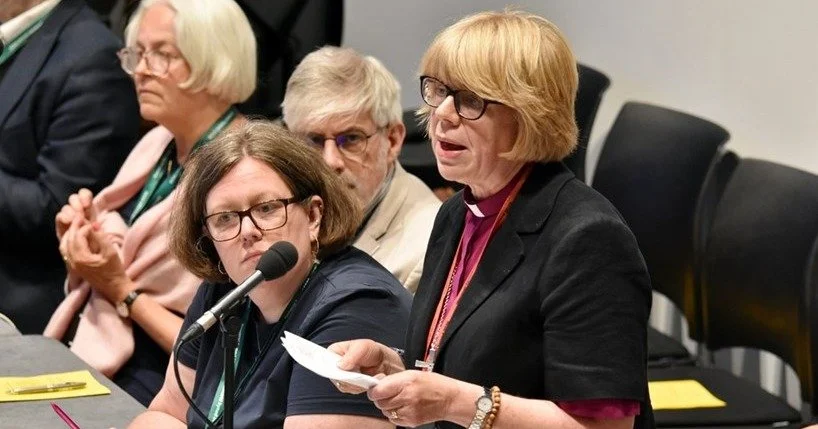
Meeting in York this July, the Church of England’s General Synod voted to hear a set of Palestinian “Kairos” documents — a wording amended down from “receive” — one of which, “Kairos II: A Moment of Truth”, describes Israel as a “colonial enterprise” waging what it calls a “genocidal war on Gaza”.
The motion carried in all three houses: Bishops 25–0, Clergy 115–20, Laity 113–27, with abstentions. Kairos II was co-written by the Revd Fadi Diab, rector of St Andrew’s, Ramallah.
The vote did not come easily. The Archbishop of Canterbury, Archbishop Mullally, spoke in favour, telling members “I am a pastor, not a politician” and calling the church to “prayer and active solidarity”, while also condemning “the abhorrent rise in anti-Semitism”.
The Chief Rabbi, Sir Ephraim Mirvis, and the Board of Deputies of British Jews urged the church to reject the document; the Chief Rabbi warned that its “extreme rhetoric” risked “undermining decades of careful relationship-building” between Christians and Jews.
The final motion laments “the loss of Israeli and Palestinian lives”, rejects “antisemitism, anti-Muslim hostility and all forms of prejudice”, and asks the UK government to work urgently for a lasting peace, citing the International Court of Justice’s July 2024 advisory opinion on the occupation.
Outside the physical walls of the Synod debate, the conditions behind it keep worsening. Between 18 March and 15 July, more than 737,000 Palestinians in Gaza were newly displaced, and by 16 July more than 86 per cent of the territory sat inside Israeli-militarised zones or under displacement orders.
Famine thresholds have been crossed or projected in Gaza, Deir al-Balah and Khan Younis — what officials are calling a “silent famine”, a return of conditions first confirmed in August 2025. Around 132,000 children under five are expected to suffer acute malnutrition this year, more than 41,000 of them severely. Over the same period, the Gaza health ministry has reported 73,066 Palestinians killed and 173,514 injured since October 2023.
The strain reaches well beyond Gaza. In the first three months of 2026, settler violence in the West Bank displaced 685 children, roughly ten times the recent average, and settler attacks and access restrictions have displaced more Palestinians in early 2026 than in all of 2025. The 20-point ceasefire agreed in October has stalled over disarmament, withdrawal and governance, and on 15 July an Israeli strike killed a family in Gaza as talks faltered.
Through all of it, the Anglican-run Al Ahli Arab Hospital in Gaza City — founded in 1882, the only Christian hospital in Gaza and run by the Episcopal Diocese of Jerusalem — has kept treating the wounded, despite repeated damage and closures.
A “silent famine” is spreading across Gaza, where around 132,000 young children are expected to go hungry this year.
Whatever people make of the Synod’s arguments, the need behind them is not in question. Children are going hungry. Families have been forced from their homes, some of them more than once. Aid is not reaching enough of them. The vote itself was careful: to listen rather than pronounce, to grieve every life lost, and to reject hatred of every kind. That is worth carrying into this week’s prayers — holding the arguments lightly and the people closely, and asking for a peace that lets ordinary life begin again in Gaza and the West Bank.
PRAYER POINTS:
We pray for the children of Gaza and the West Bank, for the families facing hunger and displacement, and for the aid workers and medics trying to reach them.
We pray for all who grieve, Israeli and Palestinian families alike, that every life lost would be honoured, and that hatred, antisemitism and anti-Muslim hostility would find no home among us.
We pray for those who carry heavy decisions and for the negotiators seeking a lasting peace, and for the staff of Al Ahli Arab Hospital, who keep treating the wounded when supplies and safety are scarce.
