
Together at the Table: Reflections from ACC-19 in Belfast
Reverend Wendy Scott - Representative, The Anglican Church in Aotearoa, New Zealand and Polynesia Anglican Consultative Council (ACC-19), Belfast, Northern Ireland
The Archbishop of Canterbury, Most Reverend Sarah Mullally, opened our gathering in Belfast with a reminder: our deepest identity is not found in our province, our theology, or where we stand in a debate, but in our shared calling as followers of Jesus Christ. I carried that word with me through everything that followed.
As we sat around tables, away from the debates, I was encouraged. People listened. They shared stories. They sought understanding before agreement.
In a gathering as diverse as ACC, that is no small achievement.
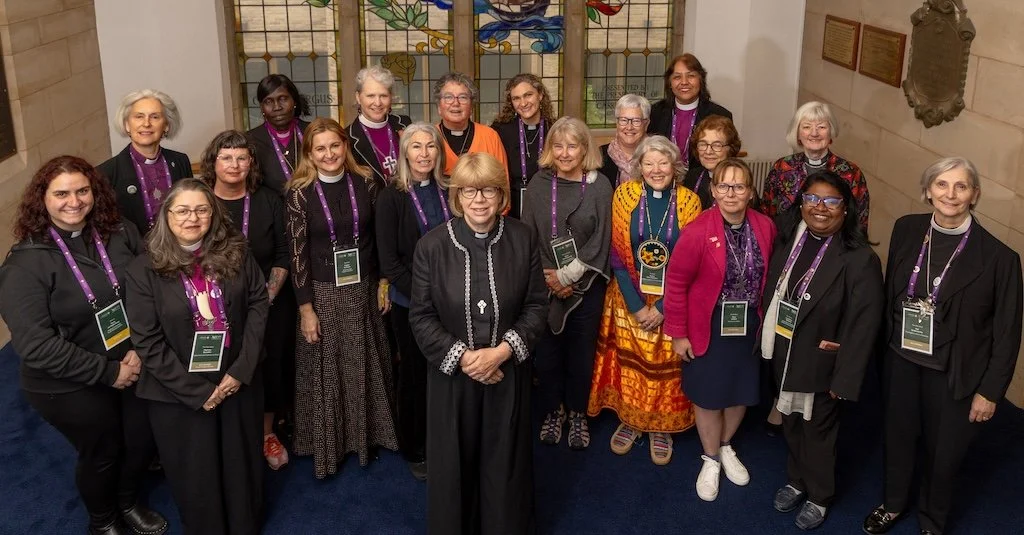
For many delegates, what mattered most was not winning an argument but remaining connected. There was a genuine desire to stay together, even where deep disagreements remain. That commitment to relationship felt profoundly hopeful.
Another profound experience came when we travelled to Londonderry (Derry) to hear stories of reconciliation and peace-building. We crossed the Peace Bridge together, physically moving from one side of a divided city to the other—a powerful symbol of the work that remains before all communities seeking healing.
There we heard Richard Moore tell his remarkable story. Blinded at the age of ten by a rubber bullet fired during the Troubles, Richard chose not to live with bitterness. Instead, he dedicated his life to forgiveness and reconciliation, eventually meeting and building a relationship with the soldier responsible for the shot that changed his life forever.
His story was deeply moving. It was a reminder that reconciliation is never abstract. It is costly, courageous, and profoundly transformative. Richard demonstrated what one person can do when they choose forgiveness over resentment and relationship over division.
Father Martin Browne, the Catholic Liaison Officer to the Anglican Communion, spoke movingly about the growing relationship between the Roman Catholic Church and the Anglican Communion. He reflected on the strengthening ties between the Pope and the See of Canterbury and the importance of praying together as Christians seeking greater unity. His address reminded us that reconciliation is not only an Anglican challenge but part of the wider Christian calling.
As a representative of the Anglican Church in Aotearoa, New Zealand and Polynesia, I was grateful for the opportunity to contribute to conversations about unity, climate change, and the voice of women within the Communion.
Yet perhaps the most important contribution we can offer is our experience of being a church that seeks to live with difference. In Aotearoa, New Zealand and Polynesia, our Three Tikanga structure teaches us that unity does not require uniformity. We remain connected while honouring different histories, cultures, and ways of being Church.
That experience resonated strongly throughout ACC-19.
Throughout history, the Church has wrestled with questions of doctrine, authority, identity, and belonging. Often, we approach these conversations convinced that we stand on the "right" side of the debate. It is an age-old pattern, and one that I observed again during our time together. Too often, it seemed to be men defending lines in the sand that I no longer see as fixed or immutable.
Much of our discussion centred on what it means to be in communion with one another, whether fully or partially, and what our relationship with the See of Canterbury signifies in the life of the Anglican Communion.
For some provinces, the idea of the Church of England as the "Mother Church" remains deeply significant. Their Anglican identity is closely tied to what is said and done in England. If the Church of England adopts a particular position, it is understood to have implications for Anglicans everywhere.
In contrast, many of us from other parts of the Communion increasingly speak of one another as sister churches. We recognise that Anglican provinces are autonomous and seek to discern God's call within their own cultural, political, and social contexts. The idea that churches might faithfully make decisions shaped by their own nationhood, indigenous traditions, and local realities was, for some, difficult to grasp.
Of course, questions of doctrine and interpretation remain at the heart of many tensions within the Communion. The distinctions we make between so-called "first-order" and "second-order" issues continue to shape our conversations. Throughout history, the Church—God's beloved bride—has argued with itself, often drawing lines that separate one group from another, each believing they are defending God's truth.
Issues surrounding the ordination of women, human sexuality, safeguarding, and authority continue to be viewed very differently across the Communion. In some parts of the world, women in the priesthood are still considered heretical. In others, language around safeguarding is confused with debates about sexuality. These differences remind us that cultural context matters deeply and that our interpretation of Scripture is always undertaken within a particular time and place.
What does it mean to remain at the table as whānau? What does it mean to stay in relationship when perspectives differ? How do we continue to listen, learn, and pray together when agreement seems distant?
These are not easy questions.
But Belfast reminded me that unity is not the absence of disagreement. Unity is the commitment to remain connected despite it.
We are bound together through our shared whakapapa in Christ, through baptism, through prayer, and through God's call to be one body.
The future of the Anglican Communion will undoubtedly continue to involve difficult conversations. Yet I left Belfast hopeful.
Hopeful because people were willing to listen. Hopeful because people were willing to stay. Hopeful because, despite our differences, there remains a deep desire to gather around the same table and seek God's future together.
In a divided world, that may be one of the most important witnesses the Church can offer.
Thanks be to God that the Holy Spirit continues to lead us in that work.
Wendy Scott,
Priest in Charge
St Matthew’s Anglican Church
Masterton
