
Living Plastic-free in a missional Christian community
What does it look like to turn environmental conviction into daily practice—especially within a faith community? This reflective piece explores one household’s commitment to plastic-free living as an act of hopeful, missional discipleship. The insights and reflections challenge the idea that meaningful change must be perfect or large-scale, inviting readers into small, creative steps toward caring for creation.
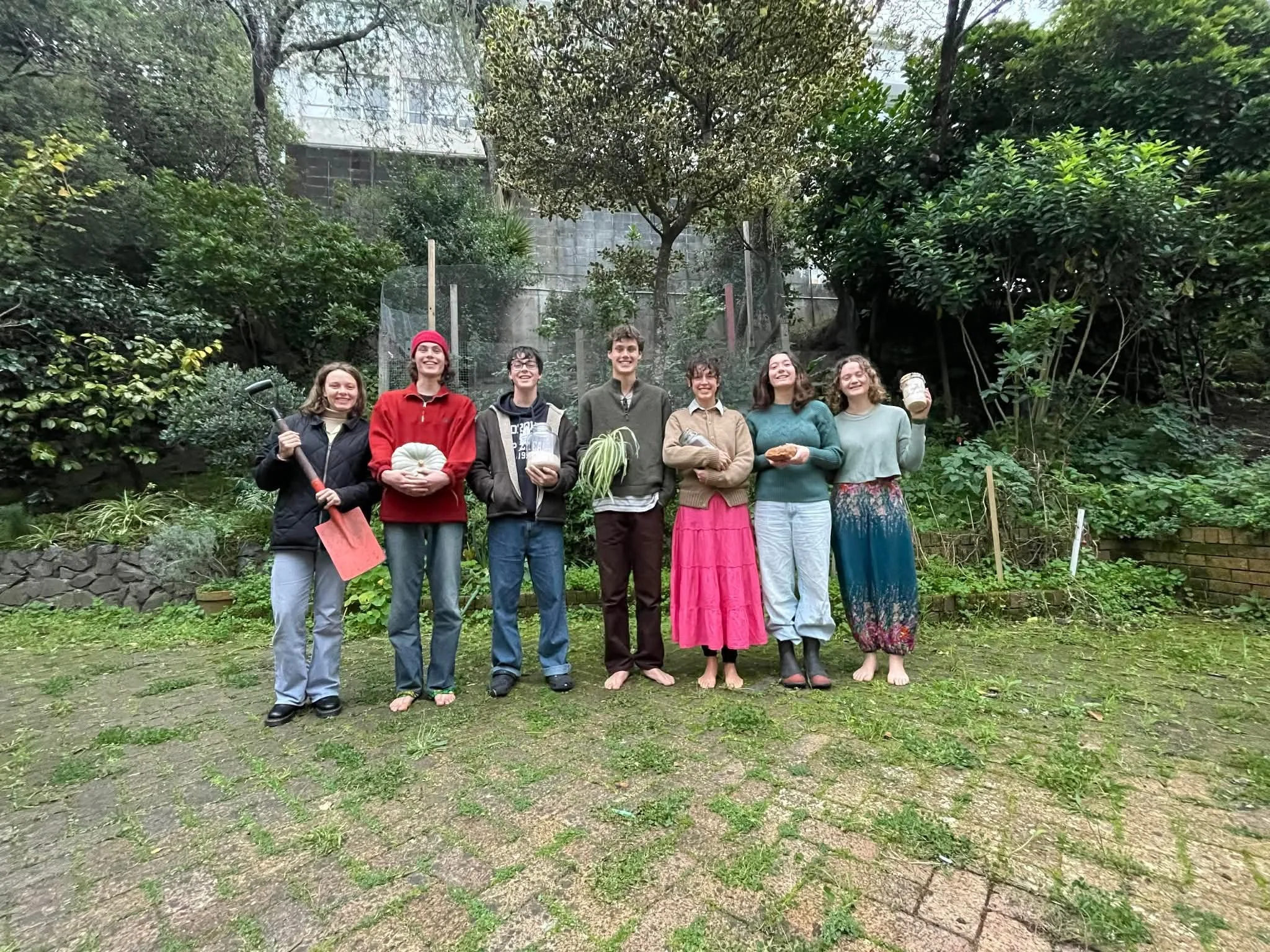
Left to Right: Elena O’Leary, Simon Langham, Jakob Johnson-Frow, Micah Langham, Claire Sparrow, Nadia Scott, Leah Werner.
Plastic-free life in a missional Christian community.
All too often, there is a stark detachment from the environmental ideals we dream of and the way in which we live our lives. I can dream of the end of fossil fuels, yet still rely on them to get around. I can dream of a reforested Aotearoa, yet simultaneously support the agriculture that demands the land. I can dream of a world rid of microplastics, yet the convenience and practicality of plastic-wrapped goods are hard to deny. It can feel overwhelming, systemic.
This year, my flatmates and I have committed to purchasing exclusively plastic-free food. The seven of us are part of the Community of the Transfiguration (known to most as ‘Transfig’) and are doing so as an act of hopeful rebellion. Transfig has a missional orientation towards students of Te Herenga Waka/Victoria University of Wellington, working through hospitality and the facilitation of safe spaces for connection and conversation. As one of the three student flats in the community, this is our primary missional focus. A conviction for environmental action and plastic-free kai is superimposed onto this missional space. Whilst we have committed to plastic-free for our collective groceries (which is food for all three meals a day), we are not demanding a purist take, and individuals purchasing a chocolate bar, for example, is quite acceptable. We are not blind to the fact that our individual actions will not change the amount of plastic pouring into our world. But we believe in a God who loves his creation, and who calls his people to be good stewards. For me, plastic-free is living the dream: the dream of a world built in relation to Te Taiao, a world that fears pollution and chases regeneration.
Eliminating plastic waste may fulfil a spiritual ideal, but the doing itself is a practical dilemma. How, in an economy fuelled by convenience, could we possibly find food free of plastic wrapping? If I could magically transport an 18th-century human into aisle five of Pak’nSave, I think they might genuinely have a hard time locating food, finding only mysterious glistening bags. This is not to say that a typical 18th-century human ate better than us (they probably ate much worse), but to point out how quickly convenience has become the unchallenged norm – and how hard it may seem to eat a different way. Supermarkets provide a bombardment of plastic-wrapped goods, so it can feel there’s no choice but to play along.
So, how have we done it? A diversification of shopping destinations has been the answer. We buy bulk dry foods, oils and peanut butter from Bin Inn (a bulk food store where you refill your own containers); we stock up on cans, jars, butter and boxes of tea at Pak’nSave; and we collect fruit, vegetables and eggs from a Sunday market. We make our own bread and muesli and drink mostly powdered milk (though we buy an expensive glass bottle or two for tea and coffee). It’s made possible in part because we’re a household of seven university students, all with the energy and time to chip in. The result of shopping with a high level of intentionality is that we’re eating well. We’re eating healthy and warm homemade foods that fill us up and meet our nutritional needs. It’s also much cheaper.
Can, and should, everyone follow suit? I feel the first stumbling block to so much potential progress is a frighteningly distant ‘perfect’ end-goal. The difference between a plastic-free life and our plastic status quo can feel so vast that residing somewhere in the middle can feel like a murky, unmotivating place to be. When we consider the scale of this issue in its entirety, cutting out just a few plastic-wrapped things can feel like a hopeless flailing towards an impossible action. But this is not true. Small actions are actions. Perhaps as a few of us make small individual changes, more options will become visible to more people, and the ability for change will compound. If replacing a couple of plastic-wrapped items in our weekly shop became our status quo, we could create a domino effect, which in its entirety could be huge. I feel it is true that change is more likely to occur, fuelled by hope than by despair. So, try changing a few things, in hopeful rebellion against an all too comfortable norm.
Replace, don’t just remove. Cutting plastic from our lives shouldn’t be painful or limiting. Take it as an opportunity to branch out, explore new foods, and eat better food. Of course, this will look different for everyone; your household may not have the same time and energy as a flat of university students. But there is bound to be something.
Perhaps you have a dusty bread-maker in a bottom drawer, yearning to make you hot bread once again. Perhaps you don’t really need that fancy muesli for breakfast, and porridge (made from oats bought in paper) will do you just fine. Perhaps deep down you miss baking muffins, but Facebook is stealing your time and creative juice, forcing you to rely on supermarket snacks instead. Options are endless. Take this as an encouragement to get creative.
Where is Jesus in all this? As part of our Transfig community commitments, we pray together every weekday morning. We use prayer books from Ngatiawa River Monastery, and every so often we pray the words, “Lord, may our impress on the Earth be kindly and creative.” I do not believe our faith should make us feel guilty for the ways in which our everyday actions impact the planet. But I do believe that our faith offers an invitation to creatively rethink the way we live, inviting us to step away from the exploitative systems that surround us. There are many systems that require change, and as Christians, we have an opportunity to stand against the flow and set an example of hope. The world needs hope, and as Christians, we have reason to hope. Through prayer, community and small everyday action, perhaps we can come to be vessels of God’s love in our communities and effective stewards of our Earth. Plastic-free living on an individual scale may have little impact on the state of our world, but I reckon a posture of hope can go a long way.
Written by Micah Langham
