
Live and Lead as a Free People – Assistant Bishop Anashuya Fletcher
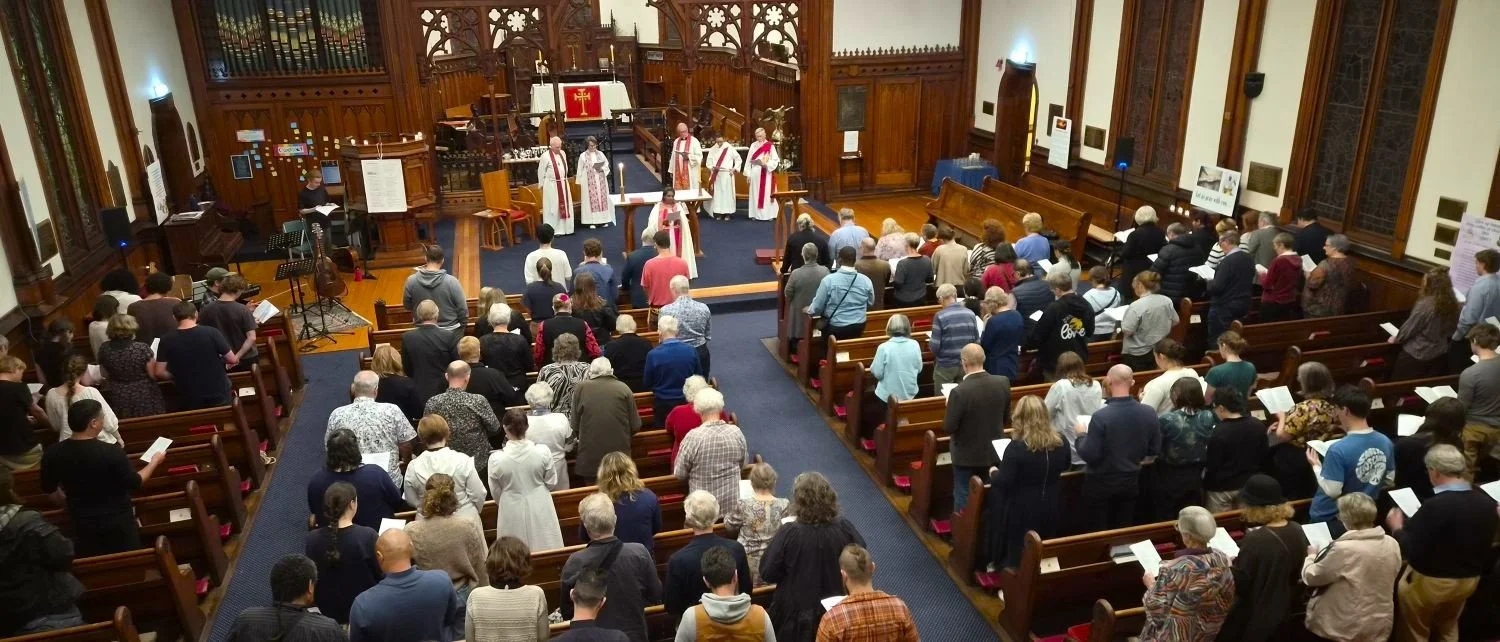
Wellington / Greytown / Whanganui — Holy Week
Assistant Bishop of Wellington Anashuya Fletcher invites us to live into the freedom offered through Christ, confronting fear, injustice, and complicity in systems that oppress others. She was speaking at the Chrism Services held during Holy Week in Wellington, Greytown, and Whanganui.
Reflecting on the Exodus story of Israel’s escape through the Red Sea, Bishop Anashuya acknowledged that the biblical narrative can be confronting. Drawing on a recent visit to the Michelangelo exhibition at Tākina in Wellington, she described viewing a Renaissance depiction of the drowning Egyptian army — an image that prompted her daughter to ask how such violence fits with the belief that Jesus loves everyone.
The question, Bishop Fletcher said, reflects a genuine struggle many Christians face when engaging with scripture. Yet she emphasised that the Exodus story also reveals a God who hears the cry of the oppressed and acts decisively to bring freedom and justice.
To illustrate this, Bishop Fletcher shared from her own experience working as a lawyer with an anti‑slavery organisation in South Asia, where she was part of a team investigating bonded labour. She described a rescue operation involving more than 20 people enslaved in a rice mill where four generations of a single family had been held captive through debt.
When local authorities issued release certificates declaring the families free, Anashuya recalled a visible transformation: fear lifted, joy emerged, and people stepped into a life entirely unfamiliar to them. The freedom was real, she noted, but it also brought uncertainty and challenge.
Turning back to scripture, Anashuya explained that the New Testament frequently uses slavery as a metaphor for sin and death, those powers that restrict human flourishing and relationship with God. Like the Israelites, Christians may know intellectually that they are free yet we still struggle to live as free people.
She pointed to the fear experienced by the Israelites after their escape from Egypt, even while God’s presence was visibly with them. Generations of bondage, she said, had shaped their inner lives. Although they had crossed out of slavery, fear still governed their responses.
Drawing on the writing of theologian Tim Keller, she noted that the Israelites crossed the Red Sea in many emotional states, with confidence, celebration, or terror. However, whatever their state, all were equally delivered.
“It is not the quality of our faith, but the object of our faith that saves us,” she said. It’s worth repeating, “It is not the quality of our faith, but the object of our faith that saves us.”
Connecting this theme to baptism, Anashuya referenced the early Christian text The Didache, which identifies “living water” — water that flows and moves — as the ideal context for baptism. Such water, she said, mirrors the Red Sea and the Jordan River: both life‑giving and dangerous. In Christ’s death on the cross, living water flows, bringing cleansing, life, and the gift of the Holy Spirit.
Despite this freedom, many Christians remain captive to fear. But fear, she said, is a defining tool of enslavement — one that continues to shape individual lives and church communities. Recalling a visit by Bishop Oscar Muriu of Kenya, she noted his observation that many believers have not fully died to themselves in following Christ, but have only “fainted” and a dead person has nothing to fear.
Addressing the broader social implications of the Exodus narrative, Bishop Fletcher challenged listeners to reflect on their own participation in systems of exploitation. In the biblical story, she said, “the Egyptians” represent enslaving power embedded in institutions and structures.
Returning to her anti‑slavery work, she described discovering that rice produced by enslaved workers bore a label familiar from her own supermarket. Even as an advocate for fair trade and justice, she found herself implicated, in systems that caused harm.
Such complicity, she said, often arises from fear, self‑interest, and disordered loves. While these forces keep individuals captive, they also perpetuate the captivity of others.
However, Anashuya emphasised that the destruction of oppressive systems in the Exodus narrative is not an end in itself. Scripture points to God’s work of re‑creating institutions and structures so that they enable human flourishing under God’s reign of justice and peace. Christians are invited to participate in that work.
Concluding her sermon, she pointed to Moses as a model for Christian leadership. Raised within the household of Pharaoh yet committed to the God who saves, Moses chose a third way, he interceded for his people, confronted injustice, and partnered with God in the work of liberation.
The call, she said, remains the same today: to expend ourselves for the freedom of others. Those trapped in modern slavery, those oppressed by unjust systems, and those held captive in body, mind, and spirit by sin and death.
“May we know the fullness of the freedom Christ gives us,” she said. “And may we continue to struggle for the freedom of others, until all are free.”
